

Last month, I had the good fortune to record a webinar and a series of videos for the Wine Scholar Guild educational platform, discussing viticulture in the Canary Islands alongside Justin Martindale MW.
One of the topics that inevitably came up was so-called “volcanism” in wine.
What is that?
Volcanism embraces a style of wines said to evoke the volcanic origin of the soils on which the vineyards are planted. Thus, when we uncork bottles of wine from the Canary archipelago, we expect to find descriptors such as flint, hot rock, ash, embers, smoke...
The Geological Universe
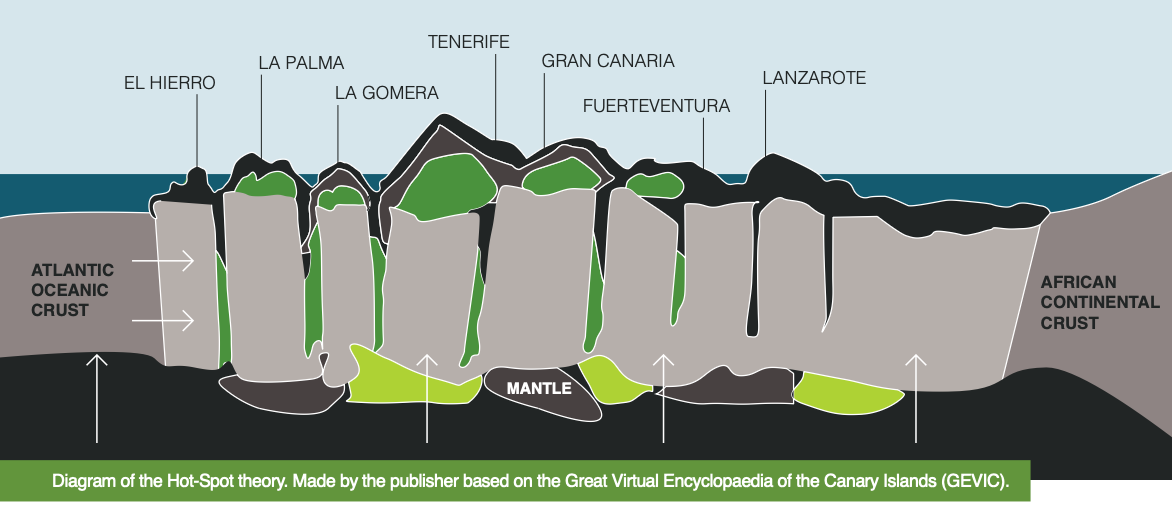
If we talk about why the Canary Islands exist as an archipelago in the middle of nowhere, there are several theories about their geological formation, but the most widely accepted seems to be the one that confirms that the archipelago grows from the northwestern African coast out toward the center of the Atlantic. In fact, if we removed the water, we would be able to see islands located beyond Lanzarote and Fuerteventura that have already disappeared beneath the sea due to erosion. We also find volcanic activity further west of El Hierro, which could be understood as the new daughters that will become part of the Canary Islands millions of years from now. In other words, this still is a region with active volcanic activity.
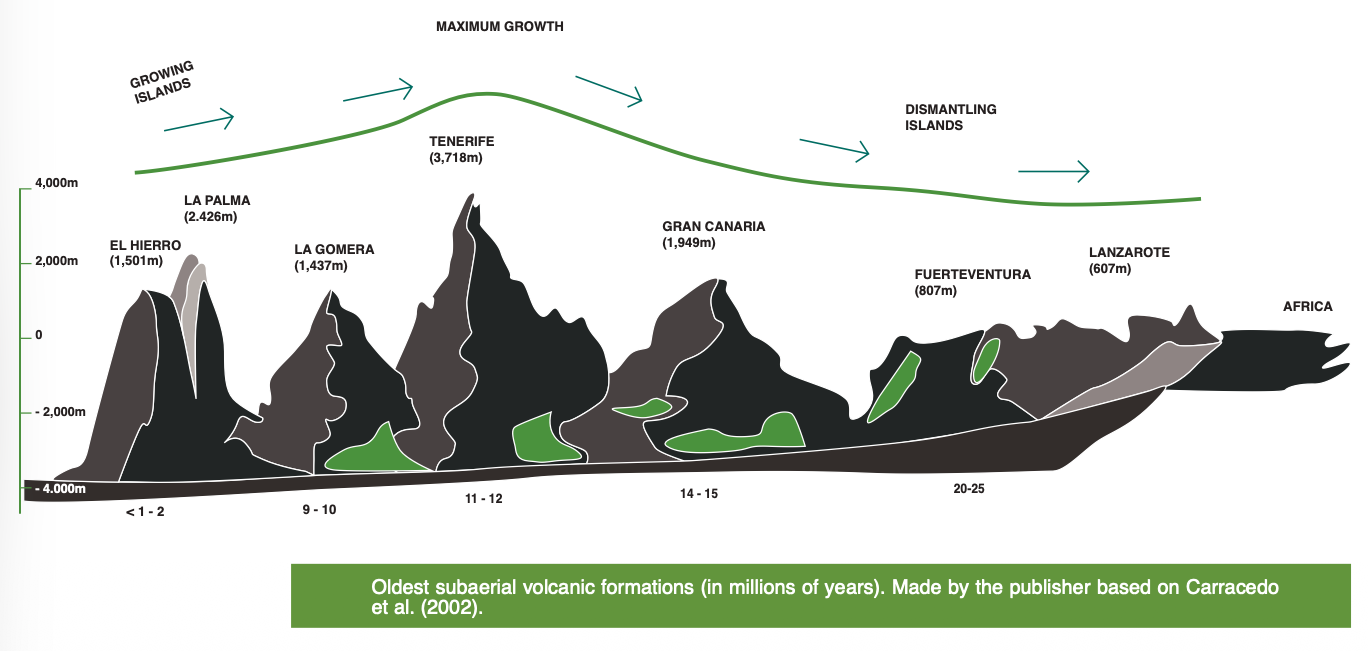
What is evident is that we cannot generalize this style to all wines from the islands because, for example, the distance between Lanzarote and El Hierro is almost equivalent to traveling from Madrid to Barcelona. Furthermore, the different eruptions and the time that has elapsed between them have given rise to very different soil compositions — not only between the different islands, but within the same island as well.
This complexity stems from the diversity of each eruption. In other words, every soil profile depends on the nature of the magma chamber that existed beneath the Earth’s crust at the moment of eruption. These eruptions are not Strombolian (with the exception of Teide, which is an anomaly), but rather originate from fissures, causing the islands to form almost as though they were the overlapping layers of a lasagna—the archipelago is probably the only terroir where layers of ancient soil alternate with layers of much younger soils.
The older soils, being more metamorphic (that is, having undergone a greater degree of compaction), are richer in iron. This is why there are parts of the islands where the soils are so reddish (iron-rich clays) and seem to contribute greater texture, structure, and depth.
The younger soils are rich in silt. They are not as compacted because, geologically speaking, 20 million years is nothing. They have solidified, yes, but they are not metamorphic. There are also young soils that remain very sandy or are covered by layers of ash from “recent” eruptions (the so-called rofe or picón).
Aesthetic choice or consequence?
Now, regardless of the nature of the soil, what seems to be relevant when discussing that volcanic profile is soil pH. It is a profile characterized by reductive aromas. And it is well known that reduction tends to arise in acidic, unbalanced soils.
We need to understand that these types of soils are richer in elements such as aluminum and sulfur. This is important because these elements create an environment of extreme acidity that causes essential nutrients to leach away and become toxic to plants.
Let me explain. Plants need nitrogen to live. Sulfur has the ability to capture nitrogen particles and push them deeper into the subsoil, making it more difficult for plants to access them. Aluminum is another source of soil toxicity, blocking plants’ ability to assimilate nutrients. On top of that, there are also very high sodium levels due to the influence of the ocean itself. In fact, there are areas where sodium accounts for 15% of the soil, levels already considered toxic.
From a technical standpoint, all of these elements act as blockers.
This seems contradictory, given that these soils are rich in organic matter, doesn’t it? The reality is that you can have all the organic matter in the world, but if it isn’t available, it achieves nothing. For that organic matter to become available, it first has to mineralize. For that to happen, certain microbiological processes need to take place in the soil.
The consequence of having so many blocking elements in Canary soils is that levels of readily assimilable nitrogen — the very nitrogen that yeasts need during fermentation — are extremely low. This is where reduction appears, because if the yeast is stressed, it will excrete sulfur.
To give you an idea, in winemaking it is generally said that around 150 mg/L of nitrogen is needed for a healthy fermentation to get underway. In these kinds of wines, levels are often around 40 mg/L, meaning the yeasts are effectively starving.
Is this an expression of terroir? I’ll leave it to you to draw your own conclusions.
What does seem clear is that many producers are trying to move away from these ultra-reductive profiles. And to achieve this, the solution appears to be proper soil management — rebalancing soils so that nutrients can be absorbed more effectively.
The only way to solve these nutrient-uptake problems is through agricultural gypsum — calcium. This element has the ability to immobilize the blocking elements, allowing the vines to begin assimilating nitrogen again.
As a result, some producers are becoming increasingly interested in the principles of regenerative viticulture, adopting practices such as planting cereals or legumes that help retain nitrogen in the soil. As cereals and legumes grow, they begin capturing atmospheric nitrogen and returning it to the soil because they need those nitrogen inputs to produce grain or fruit. This is when they are mowed and used as green manure, preventing the plant from using that nitrogen because the fruit has been removed. The nitrogen is therefore retained in the soil, which naturally benefits the vine.
Does all Volcanism come from the soil?
I want to finish with this question because we need to be careful when venturing into the world of volcanic wines. There is no doubt that, stylistically, these reductive notes are what have put these wines on the map for wine lovers. However, as with everything, once something becomes a style that sells, we can also talk about “false volcanism”.
There are other factors in the winery, of course, where very cloudy and tumultuous fermentations are encouraged. In these conditions, yeasts have more food and fermentation proceeds more quickly, but the result is dirtier aromas. This is why other practices, such as gentle pressing or must clarification, in order to carry out malolactic fermentation more cleanly, are important measures for reducing that profile. We must also bear in mind that some reductive aromas arise from the interaction between lees and new oak (toasted sesame, sunflower seeds) during long aging periods, much in the same way that some of Burgundy’s finest wines are made.
As you can see, not everything that glitters is gold. What is clear, however, is that for now, reductive profiles seem to define the stylistic playbook of the islands’ wines. A playbook that is becoming increasingly softened, so we will likely witness a paradigm shift before long.
There are many other factors that contribute to the character of island wines beyond volcanism, but I’ll talk about those in another post. I’m currently in Tenerife — at the Island Wines Summit — so I’m coming back loaded with insights that I’ll be able to share with you.
🍷
Galician Sommelier does not publish advertising or accept paid collaborations of any kind. If you like what I write, share it with anyone who enjoys discovering and experiencing new wines. And if you feel like supporting my work through crowdfunding, you can do so here. You’d be helping me bring to life the book on Galician wines that I’m currently working on 🍷
Really nice read. I'll probably spend the rest of the summer tasting across volcanic soils.
Low nitrogen in the must is also indicative of drought. According to the nitrogen cycle that I learnt about at school, a lot of soil nitrogen is deposited there by rain. So drought = less nitrogen. This is independent of the nitrogen being blocked in the soil because of the soil's chemistry which Miguel writes about. The must nitrogen difficiency is less extreme and reduction less obvious.
I saw that in my musts in the Languedoc with 80-120mg/l typically in dry years and 180 in wet ones. The wild yeast fermentations took months in dry years because of the lack of assimilable nitrogen. And reduction was a chronic problem for my wines.
Interestingly I think 2025 in Rias Baixas was also lower nitrogen than usual because of the hotter and dryer summer. My wild yeast Albariño is only just finishing fermenting now although there is more alcohol than usual and that also makes the end of the fermentation much slower.